How to Become a Kitchen Cabinet Dealer: Steps, Costs and Requirements
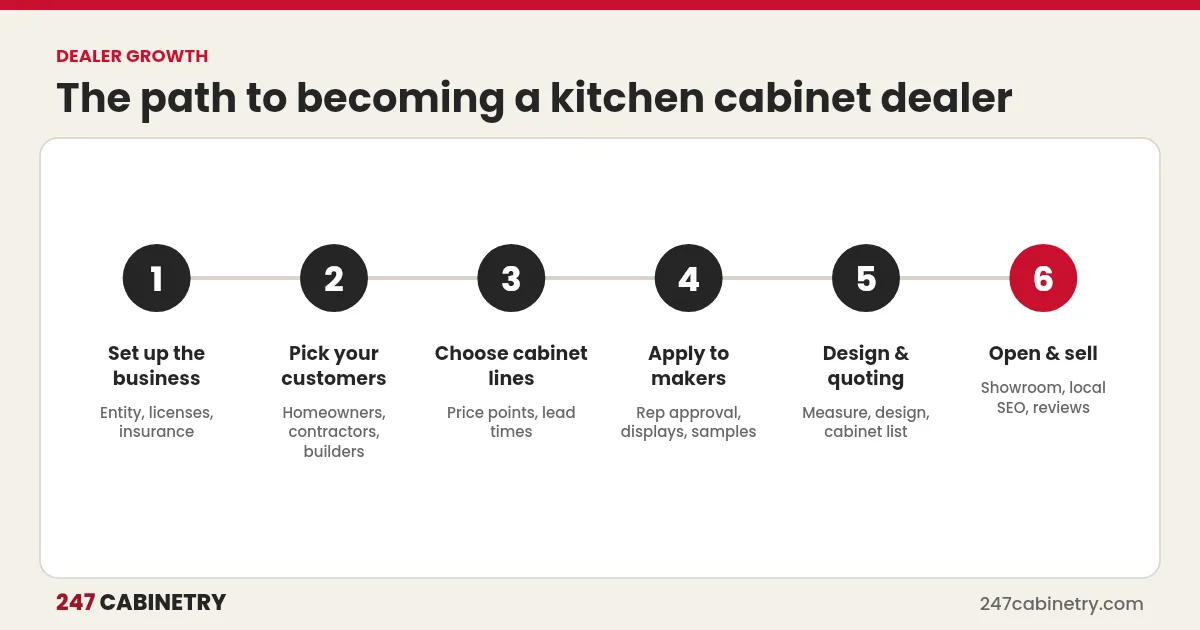
To become a kitchen cabinet dealer, set up your business, choose cabinet lines that fit your market, apply to each manufacturer (usually through its local sales representative), meet its requirements for displays, samples and volume, and put a reliable design and quoting process in place. Requirements and startup costs vary by manufacturer, so get each line’s current dealer terms in writing before you commit.
Many dealers start as contractors, remodelers, installers or designers who already sell kitchens and want better pricing and more control. Others open a showroom from scratch. Either way, the path looks similar.
Step 1: Set up the business
Before approaching manufacturers, have the basics in place:
- A registered business entity, tax registration and business bank account.
- Any local business or contractor licenses your area requires.
- Insurance appropriate for selling and, if you install, for installation work.
- A simple business plan: who you will sell to, at what price points, and how you will find customers.
The SBA’s step-by-step guide to starting a business covers registration, licenses and funding in more detail.
Step 2: Decide who you will sell to
| Customer type | What they want | What it means for you |
|---|---|---|
| Homeowners | Design help, visuals, confidence | Showroom, renderings, strong presentation |
| Remodelers and contractors | Fast quotes, accurate orders, good pricing | Quick turnaround and reliable lead times |
| Builders | Repeatable layouts, volume pricing, delivery scheduling | Capacity and consistent cabinet lists |
| Property managers and investors | Durable, cost-effective kitchens | Value lines and simple ordering |
Most dealers serve a mix, but your main customer shapes which lines, showroom and process you need.
Step 3: Choose your cabinet lines
Pick lines based on your market, not just margin:
- Price points: a value or stock line, plus a semi-custom line, covers many budgets. See stock vs. semi-custom vs. custom cabinets.
- Lead times and reliability: delays cost you customers and installers’ time.
- Styles and finishes that suit homes in your area.
- Territory: some manufacturers limit how many dealers they appoint in an area.
- Support: training, marketing materials, warranty handling and a responsive rep.
Step 4: Apply and meet the requirements
Manufacturers set their own dealer requirements. Common ones include:
| Requirement | What it can involve |
|---|---|
| Application and credit approval | Business details, references, credit terms |
| Displays | One or more kitchen or vignette displays |
| Door samples | A set of door styles and finishes |
| Literature and price books | Catalogs and specification guides |
| Minimum volume | Annual purchase targets in some lines |
| Design capability | Ability to produce layouts and orders in the line |
A JLC article on becoming a cabinet dealer describes approval often starting with the manufacturer’s sales representative, and dealers reporting startup purchases such as door selection centers and sample sets. Costs differ by line, so ask for specifics.
Step 5: Set up design and quoting
Homeowners rarely buy a kitchen without seeing it first, and contractors need accurate cabinet lists to quote. You need:
- A measuring process: see how to measure a kitchen for cabinets.
- Design capability in your lines: an in-house designer, design software or an outsourced service.
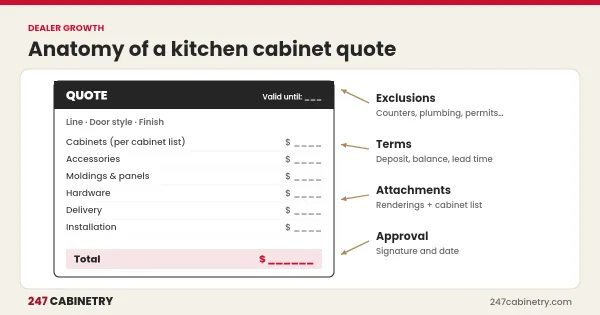
- A quoting method that turns the cabinet list into a clear price.
- An ordering check to catch missing fillers, panels and moldings before ordering.
Hiring and training a designer takes time and money. Many new dealers start with an outsourced service. With 247 Cabinetry’s kitchen design service, you send measurements and photos and usually receive a floor plan, elevations, 3D renderings and a cabinet list in your line within 24 hours, from $29.99 per design.
Step 6: Build your showroom or display area
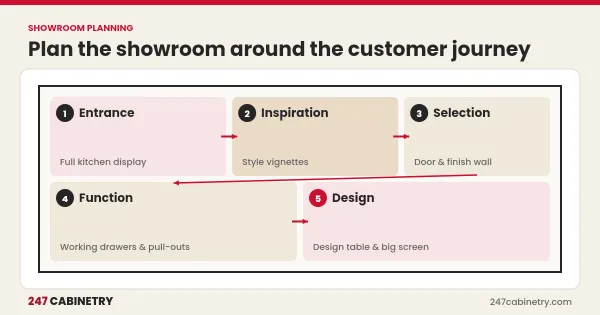
A showroom does not need to be large to work. Focus on:
- Your best-selling door styles and finishes, at full size.
- Real working storage: drawers, pullouts, corner solutions.
- A design table with a large screen for presenting renderings.
- Samples homeowners can take home.
Our guide to cabinet showroom display ideas covers layout and displays in detail.
Step 7: Price for profit
Know your costs and target margin before quoting your first kitchen. Account for freight, delivery, design time, installation coordination, warranty handling and overhead. Our guide to kitchen cabinet markup and profit margin explains the math.
Step 8: Find your first customers
- Contractors and remodelers you already know are often the fastest source of early orders.
- Google Business Profile and local search bring homeowners: see local SEO for cabinet showrooms.
- Reviews from early customers build trust quickly.
- Fast designs help you win against slower competitors.
Common mistakes new dealers make
- Taking on too many lines at once and spreading display budget thin.
- Underpricing to win early jobs, then struggling to cover overhead.
- No process for checking orders, leading to costly reorders.
- Slow design turnaround that lets homeowners shop elsewhere.
Getting started
Once you have a line, the fastest way to start selling is to offer designs from day one. Create a free account and your first design is free. See plans and pricing.
Frequently asked questions
How do I become a kitchen cabinet dealer?
Register your business, choose the cabinet lines you want to sell, contact each manufacturer or its local sales representative, meet their dealer requirements such as displays or samples, set up design and quoting, and start marketing to homeowners and contractors.
How much does it cost to become a cabinet dealer?
It varies widely by manufacturer. Costs can include door sample sets, displays, literature, design and pricing software, a showroom lease and marketing. Ask each manufacturer for its current dealer requirements before committing.
Do I need a showroom to be a cabinet dealer?
Many manufacturers expect a showroom or at least displays, but requirements differ. Some lines work with dealers who sell mainly to contractors with a small display area. Confirm with each manufacturer.
Do cabinet dealers have to do their own designs?
Dealers are usually expected to provide designs, but they do not have to draw them in-house. Many use an outsourced kitchen design service to produce layouts, renderings and cabinet lists in their lines.
Sources
Need this kitchen designed?
Upload your measurements and get 2D plans, elevations and 3D renderings in 24 hours.
Sign up for design service