Kitchen Cabinet Markup and Profit Margin: How Dealers Price Cabinets
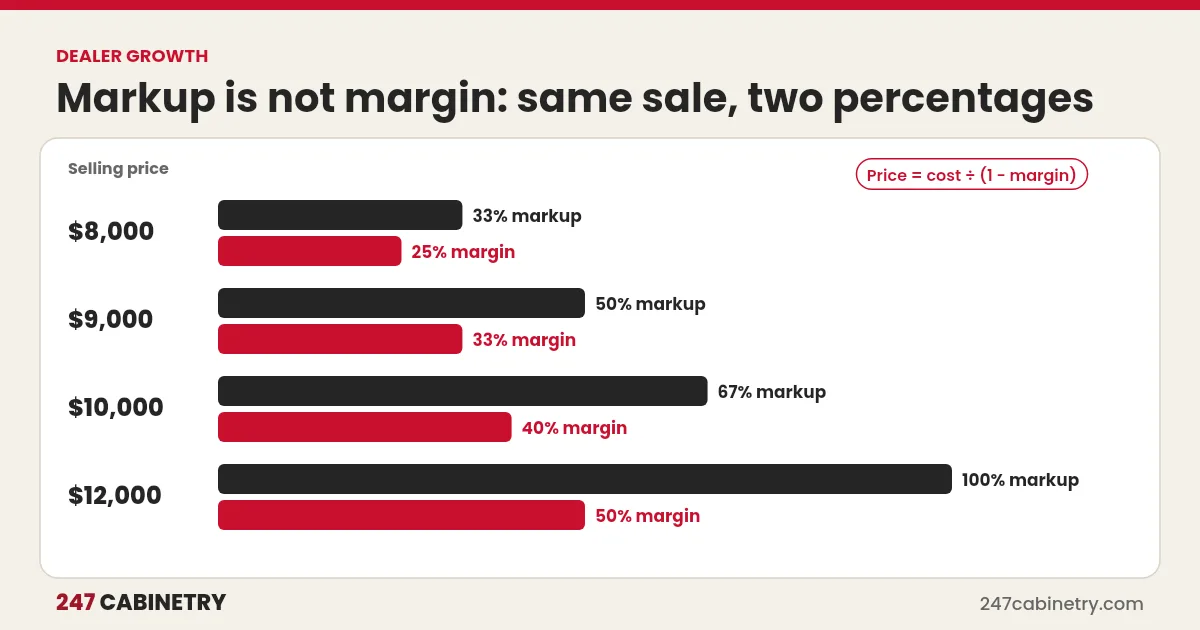
Cabinet dealers price kitchens by starting from their total cost and applying a target gross margin. Margin is profit as a share of the selling price, so the formula is: price = cost ÷ (1 − margin). A 40% margin on a $6,000 cost means a $10,000 price, which is a 66.7% markup. Gross margin then has to cover rent, salaries, marketing and other overhead before any net profit remains.
Pricing mistakes are one of the most common reasons new dealers struggle. Confusing markup with margin, or leaving costs out, can turn a busy year into a break-even one.
Markup vs. margin
| Term | Based on | Formula |
|---|---|---|
| Markup | Cost | (Price − Cost) ÷ Cost |
| Gross margin | Selling price | (Price − Cost) ÷ Price |
The same sale gives two different percentages:
| Cost | Price | Markup | Margin |
|---|---|---|---|
| $6,000 | $8,000 | 33.3% | 25% |
| $6,000 | $9,000 | 50% | 33.3% |
| $6,000 | $10,000 | 66.7% | 40% |
| $6,000 | $12,000 | 100% | 50% |
These are worked examples to show the math, not recommended prices.
Markup to margin conversion
| Markup | Equals margin of |
|---|---|
| 25% | 20% |
| 33.3% | 25% |
| 50% | 33.3% |
| 66.7% | 40% |
| 100% | 50% |
If your goal is a 40% margin and you add 40% to cost, you actually earn about a 28.6% margin.
What margin do dealers aim for?
There is no single correct number. Trade coverage in Kitchen & Bath Design News has long referred to a 40% gross profit goal for kitchen dealers, and notes that average net profit for dealers is far lower once overhead is paid. Builder work, contractor pricing and value lines are often priced thinner, while full-service design and project management can support higher margins. Use your own costs and market to set targets.
What belongs in your cost?
Many dealers calculate cost using only the cabinet invoice. A truer cost includes:
- Cabinets, hardware, moldings, fillers and panels.
- Freight and delivery to the job site.
- Design time, including revisions.
- Measuring visits and project coordination.
- An allowance for order errors, damage and remakes.
- Warranty handling and service calls.
- Payment processing fees.
If installation is part of the sale, price it separately with its own labor, insurance and margin.
Gross margin is not profit
Gross margin pays for running the business:
| Overhead item | Examples |
|---|---|
| Facility | Showroom rent, utilities, displays |
| People | Salaries, commissions, benefits |
| Sales and marketing | Website, ads, reviews, samples |
| Software and tools | Design, quoting and accounting software |
| Admin | Insurance, accounting, banking fees |
Know your monthly overhead and the gross profit you need each month to cover it. That tells you how many kitchens you need to sell at your target margin.
How to price design work
| Approach | How it works | Effect |
|---|---|---|
| Free design | Included in cabinet price | Attracts more requests, including shoppers |
| Design fee credited to order | Fee paid upfront, credited if they buy | Filters casual shoppers |
| Separate design fee | Paid regardless of purchase | Covers design time fully |
Outsourcing design changes the math: at 247 Cabinetry a single kitchen design is $29.99 and most complete requests are delivered within 24 hours, so design cost per sold kitchen is predictable. See our pricing page.
How to protect your margin
- Check every order for missing fillers, panels and moldings before submitting.
- Quote from an accurate cabinet list, not estimates. See how to write a kitchen cabinet quote.
- Avoid unlimited free revisions; set clear limits.
- Sell on value: design quality, service and reliability, not just price.
- Track margin by job so you see which customers and lines are profitable.
Pricing different customer types
Many dealers set different target margins for different customers. Homeowners who receive design, project coordination and service often support higher margins, while contractors and builders buying in volume expect sharper pricing and need less hand-holding. Write down your target margin for each type, and make sure lower-margin work still covers its share of overhead before accepting it.
Pricing checklist
| Item | Done |
|---|---|
| True cost includes freight, design and error allowance | |
| Target margin set by customer type | |
| Price calculated with cost ÷ (1 − margin) | |
| Installation priced separately | |
| Monthly overhead and break-even known | |
| Margin tracked on every job |
Next steps
Fast, accurate designs help you quote confidently and close sooner. Learn about our kitchen design services for dealers, and if you are just starting out, read how to become a kitchen cabinet dealer.
Frequently asked questions
What is a typical profit margin on kitchen cabinets?
It varies by market, line and customer type. Trade publications have long cited a gross profit goal of around 40% for kitchen dealers, while builder and contractor work is often priced thinner. Net profit after overhead is much lower.
What is the difference between markup and margin?
Markup is the amount added to cost, expressed as a percentage of cost. Margin is gross profit expressed as a percentage of the selling price. A product costing $6,000 sold for $10,000 has a 66.7% markup and a 40% margin.
How do I calculate a selling price for a target margin?
Divide your total cost by one minus the target margin. For a $6,000 cost and a 40% margin: 6,000 ÷ 0.60 = $10,000.
Should dealers charge for kitchen design?
Many dealers charge a design fee or retainer that is credited toward the order, which filters out casual shoppers. Others include design in the cabinet price. Either way, design time is a real cost to include.
Sources
Need this kitchen designed?
Upload your measurements and get 2D plans, elevations and 3D renderings in 24 hours.
Sign up for design service