Inset vs. Overlay Cabinet Doors: Full Overlay, Partial Overlay and Inset
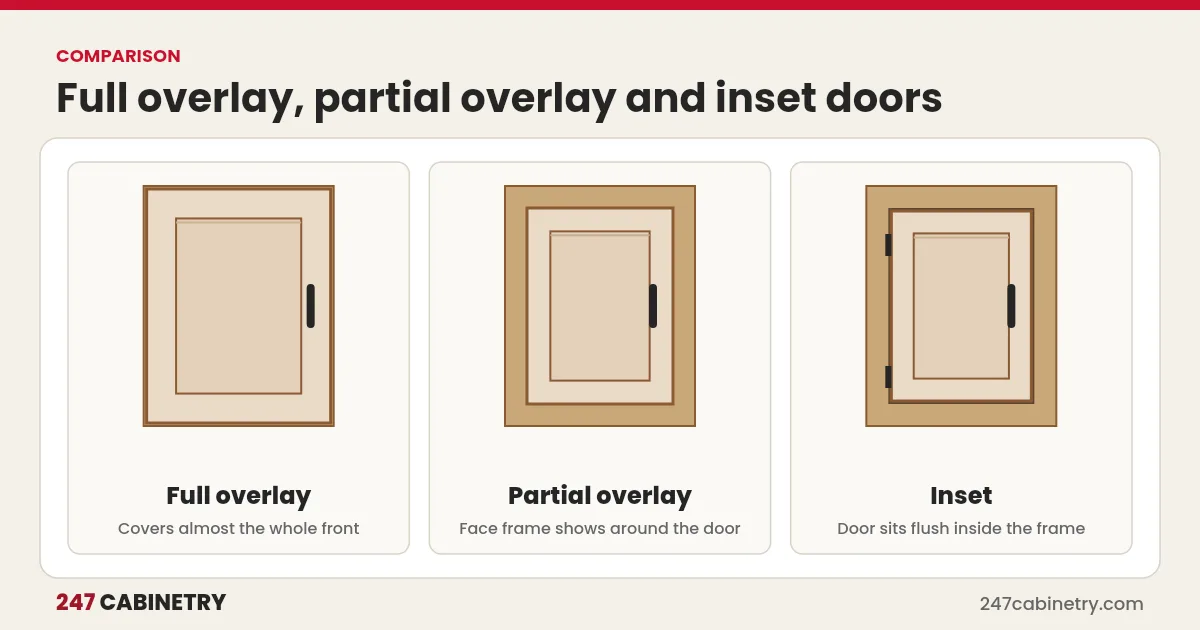
Overlay cabinet doors sit on the front of the cabinet: full overlay doors cover almost the entire front for a clean, modern look, while partial overlay doors leave part of the face frame showing and are often the most economical. Inset doors sit inside the face frame, flush with it, for a traditional, furniture-like look. Inset usually costs more, gives slightly less storage access and needs precise fitting, so the right choice depends on style, budget and maintenance.
Door style gets most of the attention in a kitchen, but how the door sits on the cabinet changes the look just as much. Here is how the three options compare.
The three door mounting styles
| Style | How it sits | Look |
|---|---|---|
| Full overlay | Covers nearly all of the cabinet front | Clean, continuous, modern or transitional |
| Partial overlay | Covers part of the face frame, which shows around the door | Traditional, classic builder style |
| Inset | Sits inside the face frame, flush with it | Furniture-like, traditional, high-end |
Full overlay
Full overlay doors and drawer fronts cover almost the whole cabinet, leaving small, even gaps between them. On frameless cabinets, full overlay is standard. On framed cabinets, the doors cover most of the face frame. The result is a smooth, continuous front that suits modern and transitional kitchens, and it gives good access to the interior because the opening is large.
Partial overlay
Partial overlay doors are smaller than the opening plus frame, so a band of face frame shows around each door. This style has been common in builder-grade kitchens for many years. It is usually the most economical option, and small gaps in alignment are less noticeable. The look is more traditional and busier than full overlay because of the visible frame.
Inset
Inset doors sit inside the face frame with a small, even gap all around. The fronts are flush with the frame, which gives a crafted, furniture-like appearance seen in classic and period kitchens. Inset cabinets need precise construction and installation, because uneven gaps are easy to see. Hinges may be exposed barrel hinges or concealed hinges designed for inset doors.
How they compare
| Factor | Full overlay | Partial overlay | Inset |
|---|---|---|---|
| Typical cost | Moderate | Lower | Higher |
| Storage access | Best | Good | Slightly reduced |
| Precision needed | Moderate | Lowest | Highest |
| Visible frame | Little or none | Yes | Yes, flush with doors |
| Style | Modern, transitional | Traditional, builder | Traditional, high-end |
Maintenance and wood movement
Wood expands and contracts with changes in humidity, as the USDA Wood Handbook explains. With inset doors, the gap between the door and frame is small and visible, so seasonal movement or a shift in the house can make a door rub or the gaps uneven. Adjustable hinges help, and homeowners should expect occasional adjustment. Overlay doors hide small changes better because the gaps are on the face rather than inside a frame.
Cost and lead time
Inset cabinets usually cost more and may have longer lead times, depending on the cabinet line. If the budget is tight but the homeowner loves the inset look, a full overlay door with a shaker style and a traditional finish can give a similar feel at a lower price. Mixing is possible too, such as inset on a feature island and full overlay elsewhere, if the line supports both.
How to help homeowners choose
Show the three options side by side in the showroom or in renderings. Open drawers and doors on each, and point out the visible frame, the gaps and the interior access. Ask whether the homeowner prefers a clean, modern look or a classic, crafted look, and how they feel about occasional adjustments. Our cabinet showroom display ideas include tips for showing door options.
How door mounting affects the rest of the design
Door mounting affects more than looks. Inset cabinets can reduce the usable width of drawers and pull-outs slightly, so check interior dimensions for items like trash pull-outs or cookware drawers. Hardware placement changes too: on inset doors, knobs and pulls sit on the door within the frame, which can look more traditional. Fillers and panels need the same style as the doors so the run looks consistent; see our guide to cabinet filler strips and panels.
Door mounting checklist
| Item | Done |
|---|---|
| Style chosen: full overlay, partial overlay or inset | |
| Construction confirmed: framed or frameless | |
| Interior access checked for pull-outs | |
| Hinge type confirmed | |
| Cost and lead time compared | |
| Homeowner shown samples or renderings |
See it in your design
Renderings make the difference between full overlay and inset easy to see before ordering. Our kitchen design service renders the design in the exact door style and mounting you sell. Related reading: framed vs. frameless cabinets and shaker vs. flat-panel doors.
Frequently asked questions
What is the difference between inset and overlay cabinets?
Overlay doors sit on top of the cabinet front, covering part or most of it. Inset doors sit inside the face frame so the door is flush with the frame.
Are inset cabinets more expensive?
Usually yes. Inset doors need tighter tolerances, more careful construction and installation, and often specific hinges, which adds cost.
Do inset cabinets have less storage?
Slightly. The face frame and the door sitting inside it reduce the opening a little, so drawers and shelves can be a bit narrower than in full overlay cabinets.
Which cabinet door style is most modern?
Full overlay doors, especially on frameless cabinets, give the most continuous, modern look with minimal gaps.
Sources
Need this kitchen designed?
Upload your measurements and get 2D plans, elevations and 3D renderings in 24 hours.
Sign up for design service