Cabinet Filler Strips, Scribe Molding and End Panels Explained
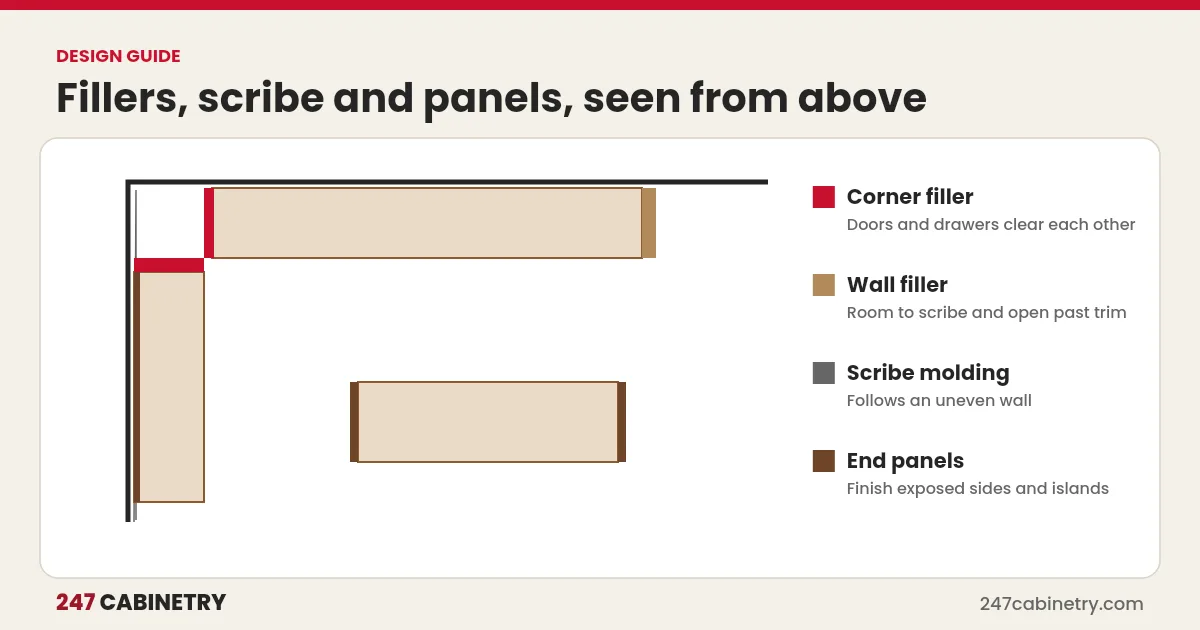
Cabinet filler strips are finished strips that close gaps between cabinets and walls and give doors and drawers room to open, especially at inside corners. Scribe molding covers small uneven gaps where cabinets meet walls that are not straight. End panels finish exposed cabinet sides, and appliance panels finish dishwasher and refrigerator openings. Planning these pieces in the design avoids most installation delays.
Cabinets come in fixed widths, usually in 3-inch steps, and rooms almost never do. Fillers, scribe and panels are what make standard cabinets fit a real room and look built in.
What each piece does
| Piece | Where it goes | Purpose |
|---|---|---|
| Wall filler | Between a cabinet and a wall | Closes the gap and lets doors open past trim |
| Corner filler | At inside corners | Keeps drawers and handles from colliding |
| Between-cabinet filler | Between two cabinets | Adjusts spacing or centers a sink or range |
| Scribe molding | Along walls, floors and ceilings | Covers small uneven gaps |
| End panel | Exposed cabinet sides | Finished look, especially at islands and runs’ ends |
| Appliance panel | Dishwasher or refrigerator | Matches the appliance to the cabinets |
| Toe kick | Bottom of base cabinets | Covers the recessed base |
Wall fillers
Walls are rarely perfectly flat or plumb, and window or door trim often sticks out. A wall filler, cut to fit on site, closes the gap between the last cabinet and the wall and keeps the door from hitting trim. Designers often leave a small filler at each wall end so the installer has room to scribe the run to the wall.
Corner fillers
At inside corners, drawers and doors on one run can hit the handles on the other. A corner filler moves the cabinets slightly away from the corner so everything opens. Blind corner cabinets have their own pull distance from the corner, set by the cabinet line. Our guide to corner cabinet solutions shows the options from above.
Scribe molding and wall irregularities
Scribe molding is a thin strip that bends slightly to follow a wavy wall, covering the gap between the cabinet and the wall, floor or ceiling. Wood also moves with humidity, as the USDA Wood Handbook explains, so a small allowance for movement helps the finished kitchen look tidy over time.
End panels and appliance panels
Exposed cabinet sides, such as the end of a run or the back and sides of an island, look better with a finished end panel, especially with paint or stain where unfinished sides would show. Dishwashers and refrigerators can take panels that match the cabinets when the appliance is panel-ready. Panels for these openings must be in the order, or the kitchen will not look finished on installation day.
How to size fillers
Filler sizing depends on the cabinet line, hardware, door overlay and the room. General principles:
- Measure the wall at several heights, because walls are rarely straight.
- Subtract cabinet widths from the wall length to find the space for fillers.
- Split the remainder between ends or place it where it looks best, such as beside a range.
- Leave room to scribe at walls.
- Check corners and appliances for door and drawer clearance.
Our guide on how to measure a kitchen for cabinets covers measuring in detail.
Common filler and panel mistakes
- No corner filler, so drawers hit handles.
- No filler at a wall with protruding trim, so doors cannot open fully.
- Forgetting end panels on islands or exposed ends.
- Forgetting dishwasher or refrigerator panels.
- Fillers placed where they look awkward, such as one wide filler in the middle of a run.
- Toe kick and moldings missing from the order.
Reading fillers on a design
On elevations, fillers appear as narrow strips labeled with codes such as F3 or WF3, depending on the line. Panels are labeled with their own codes. Our guide to kitchen cabinet codes explains common prefixes.
A note for frameless cabinets
Frameless cabinets with full overlay doors leave very small gaps, so fillers are even more important at corners, walls and appliances. Without them, a door may not open past an adjacent appliance handle or a wall with trim. Many frameless lines offer specific fillers and panels designed to match their door thickness, so use the line’s own parts rather than generic material.
Installers appreciate a design that shows filler sizes clearly. When the elevations state where each filler goes and its approximate width, the installer can start confidently and only fine-tune on site, instead of solving the puzzle in the homeowner’s kitchen.
Filler and panel checklist
| Item | Done |
|---|---|
| Corner fillers at every inside corner | |
| Wall fillers where trim or walls interfere | |
| End panels on exposed sides and islands | |
| Appliance panels for panel-ready appliances | |
| Scribe molding and toe kick ordered | |
| Fillers shown on elevations |
Get fillers right in the design
Our kitchen design service shows fillers, panels and moldings on elevations and in the cabinet list, so nothing is missed when ordering. See kitchen design mistakes to avoid for more ordering pitfalls.
Frequently asked questions
What is a cabinet filler strip?
A filler strip is a piece of finished material, matching the cabinets, used to fill gaps between cabinets and walls or between cabinets, so doors and drawers can open and the run fits the space.
Why do you need fillers at corners?
At an inside corner, drawers and doors on one run can hit the handles or fronts on the other. A filler moves the cabinets apart so everything opens fully.
What is scribe molding?
Scribe molding is a thin, flexible strip that covers small, uneven gaps where cabinets meet walls, floors or ceilings that are not perfectly straight.
What is the difference between a filler and an end panel?
A filler fills a gap in the front of a cabinet run. An end panel covers the exposed side of a cabinet for a finished look.
Sources
Need this kitchen designed?
Upload your measurements and get 2D plans, elevations and 3D renderings in 24 hours.
Sign up for design service