Cabinet Hinge Types Explained: Concealed, Exposed and Soft-Close
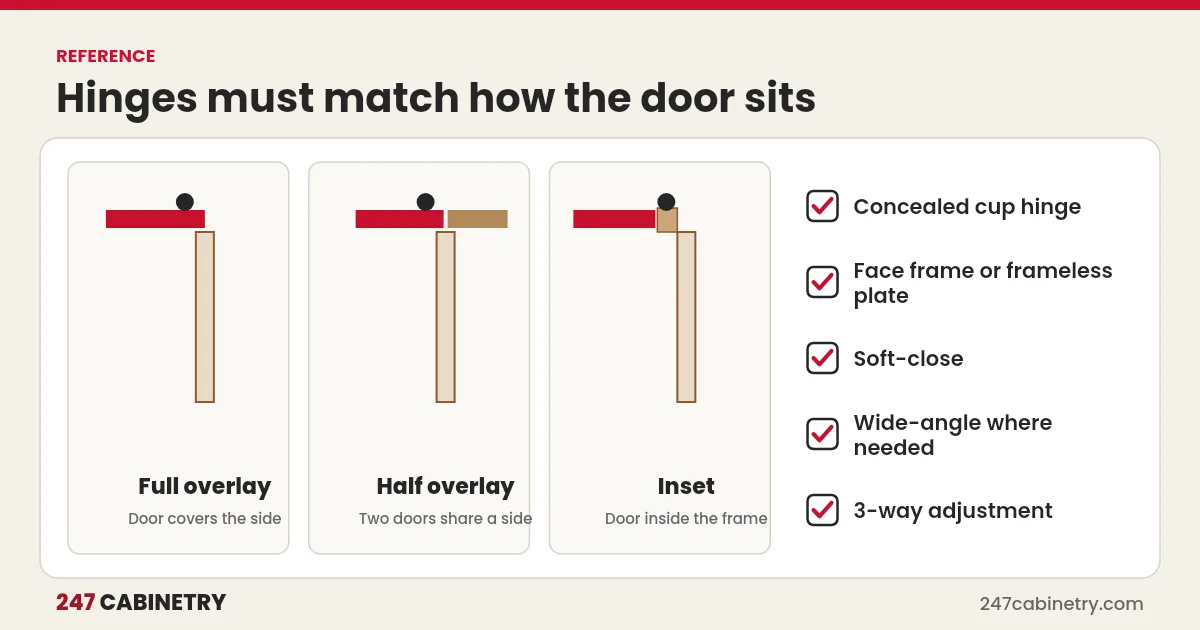
Most modern kitchen cabinets use concealed cup hinges, often called European hinges, which are hidden when the door is closed and adjust in several directions. The hinge must match how the door sits: full overlay, half overlay or inset, and face frame and frameless cabinets use different mounting plates. Soft-close hinges stop doors from slamming, and special opening angles help corner cabinets and doors next to walls.
Hinges are easy to overlook until a door rubs, sags or will not open past an appliance. Understanding the main types helps dealers specify the right options and helps installers adjust doors properly.
Main hinge types
| Type | Visible when closed? | Common use |
|---|---|---|
| Concealed (cup or European) hinge | No | Most modern framed and frameless cabinets |
| Exposed barrel or butt hinge | Yes | Traditional and inset furniture-style cabinets |
| Semi-concealed hinge | Partly | Some traditional framed cabinets |
| Specialty hinges | Varies | Corner cabinets, lift-up doors, glass doors |
Concealed cup hinges
Concealed hinges mount in a round cup drilled into the back of the door and attach to a mounting plate inside the cabinet. They are hidden when the door is closed, and many allow adjustment in three directions: side to side, up and down, and in and out. That makes it easy to even out gaps after installation. Many are clip-on, so doors can be removed without tools for finishing or cleaning.
Overlay and inset hinges
The hinge must match the door mounting:
| Mounting | Hinge style | What it does |
|---|---|---|
| Full overlay | Full overlay hinge | Door covers almost the entire cabinet side |
| Half overlay | Half overlay hinge | Two doors share one side or partition |
| Inset | Inset hinge | Door sits inside the frame, flush with it |
Our comparison of inset vs. overlay cabinet doors explains how each looks.
Face frame vs. frameless
Face frame cabinets need hinges or mounting plates designed to attach to the frame, while frameless cabinets mount the plate directly to the cabinet side. Using the wrong type leads to doors that do not sit correctly. See framed vs. frameless cabinets for the construction difference.
Opening angles
Standard concealed hinges typically open to around 100 to 110 degrees. Wider-angle hinges, often around 155 to 170 degrees, help when:
- A door is next to a wall or a tall cabinet and needs to open fully.
- Pull-out shelves or drawers inside need clearance past the door.
- Corner cabinets need wider access.
Limited-angle hinges or stops can keep a door from hitting an adjacent appliance or wall. Exact angles depend on the hinge maker.
Soft-close
Soft-close hinges include a damper that slows the door at the end of its swing so it closes quietly and gently. Many cabinet lines include soft-close as standard, while others offer it as an upgrade. Add-on dampers can be fitted to some existing hinges. Soft-close drawer slides work similarly for drawers.
Specialty hinges
- Blind corner hinges for doors on blind corner cabinets.
- Pie-cut or bifold corner hinges for lazy susan doors.
- Lift-up mechanisms for upper cabinets that open upward.
- Glass door hinges for frameless glass doors.
- Thick door hinges for heavy or deep doors.
Ease of use
Hinges affect how easily doors open. Soft-close and well-adjusted hinges make doors easier to use, and for accessibility, operable parts that work without tight grasping or twisting, as the 2010 ADA Standards describe, help everyone. Pair good hinges with easy-to-grip hardware; see our cabinet hardware placement guide.
Common hinge problems and fixes
| Problem | Likely fix |
|---|---|
| Door sags or gap uneven at top | Adjust height or side-to-side screws |
| Door does not close flush | Adjust depth screw |
| Door rubs the next door | Adjust side-to-side screw |
| Door slams | Add or adjust soft-close damper |
| Door hits wall or appliance | Use a filler or a limited-angle hinge |
Specifying hinges in a design
On most manufactured cabinet lines, hinges come with the cabinet and the main choice is the hinge side and any upgrades such as soft-close or wide-angle hinges. Mark hinge sides on the design so doors open toward the work area, not into a wall or another door. Check doors next to refrigerators and ranges, where a door that opens the wrong way is a daily annoyance. When the line offers optional hinge upgrades, list them on the cabinet list so they are priced and ordered.
Hinge checklist
| Item | Done |
|---|---|
| Door mounting confirmed (full, half, inset) | |
| Face frame or frameless plates | |
| Soft-close included or added | |
| Wide-angle hinges where needed | |
| Corner and specialty hinges specified | |
| Hinge side marked on the design |
Get hinge sides right in the design
Our kitchen design service shows door swings on the plans and lists cabinets in your line, so hinge sides and options are clear before ordering. See also cabinet filler strips and panels.
Frequently asked questions
What type of hinges do kitchen cabinets use?
Most modern cabinets use concealed cup hinges, often called European hinges, which are hidden when the door is closed and can be adjusted. Some traditional and inset cabinets use exposed hinges.
What is the difference between full overlay and half overlay hinges?
Full overlay hinges let the door cover the cabinet side almost completely. Half overlay hinges are used when two doors share one cabinet side or partition, each covering half of it.
What is a soft-close hinge?
A soft-close hinge has a built-in damper that slows the door in the last part of its swing so it closes quietly instead of slamming.
How do you adjust cabinet hinges?
Many concealed hinges have screws that move the door side to side, up and down, and in and out, so gaps can be evened out after installation. Follow the hinge maker’s instructions.
Sources
Need this kitchen designed?
Upload your measurements and get 2D plans, elevations and 3D renderings in 24 hours.
Sign up for design service